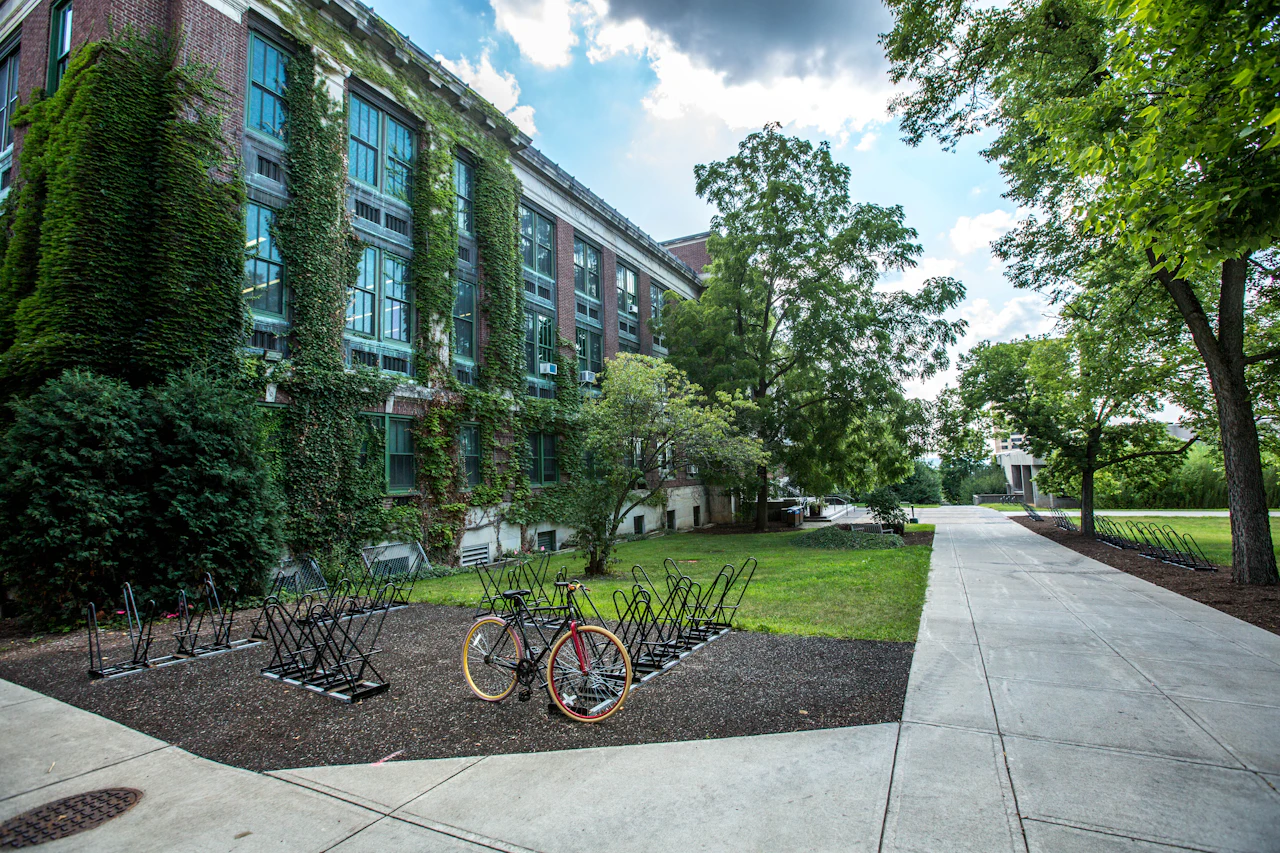
Student housing in Denmark: Kollegium and ungdomsbolig
Many students search for “kollegium” (a student residence or hall), “ungdomsbolig” (youth housing) and “studiebolig” (student housing) as if they were the same thing. They aren’t. The type of housing decides where you apply, how long you can stay and whether the landlord can give you notice when you finish your studies. If you pick the wrong one, you can end up on the wrong waiting list or be caught off guard by a notice to leave in the middle of your master’s thesis year.
This guide explains the differences in plain terms, takes you step by step through the waiting lists and gives you an overview of what the study activity requirement means in practice. At the end there is advice for both tenants and landlords.
In short
- Almene ungdomsboliger (non-profit youth housing) and most kollegier are reserved for young people in education and young people with a special need. They are often cheap, but you must document that you are an active student, and as a general rule you have to move out when you finish.
- There is no single national waiting list in Denmark. You apply through the local shared waiting list, through housing organisations or directly to the individual kollegium.
- Private “student housing” is not all the same. Some of it is special private youth housing with a study requirement. Some of it is ordinary rental housing that is simply marketed to students, in which case the ordinary rules of the Danish Rent Act (lejeloven) apply.
- Boligstøtte (housing benefit) generally requires your own kitchen. A kollegium room with a shared kitchen therefore normally doesn’t qualify for boligstøtte.
Kollegium, ungdomsbolig and studiebolig: what’s the difference?
The words are used loosely in listings and on waiting lists. Legally, what matters is who owns the housing and which law it was built under. Social- og Boligstyrelsen (the Danish Agency for Social Services and Housing) divides youth housing into four groups, and on top of that there are ordinary private rental homes let to students.
Almene ungdomsboliger
An almen ungdomsbolig is owned by an almen boligorganisation, a non-profit housing organisation often called a “boligforening”. Under section 52 of almenboligloven (the Social Housing Act, in Danish), the housing organisation must allocate vacant youth housing to young people in education and other young people with a special need. Under section 53, the board must make sure the homes are always occupied by people who are eligible, including students who are actively studying.
The housing organisation itself decides, based on its own guidelines, who gets a vacant home. According to Social- og Boligstyrelsen, it can for example take into account the distance to your place of study, your finances and your current housing situation.
Kollegier
“Kollegium” is an everyday term. Many kollegier today are almene ungdomsboliger. Others are owned by self-governing institutions (selvejende institutioner) and were built with public funding under older rules. They are aimed at the same group of people, but according to Social- og Boligstyrelsen they follow boligbyggeriloven (the Housing Construction Act) and lejeloven rather than the rules for non-profit housing. Some kollegier select residents themselves based on a motivated application, or have special requirements, such as a particular course of study.
Private youth housing and student housing
There are three variants here, and this is where many people get confused:
- Subsidised private youth housing (støttede private ungdomsboliger). These were built with public funding between 2004 and 2008 and follow the Act on subsidised private youth housing (lov om støttede private ungdomsboliger). You must be in education.
- Unsubsidised private youth housing (ustøttede private ungdomsboliger). Since 1 July 2024, private developers have been able to build homes that legally must be let to students. A declaration must be registered (tinglyst) on the property, and tenants must be active students or in education (lov om boligforhold, chapter 1 a, in Danish).
- Ordinary private rental homes marketed as student housing. These can be small flats or rooms that the landlord would like to let to students. If the home is not one of the special types of youth housing, the ordinary rules of lejeloven apply. In that case, the landlord generally can’t give you notice just because you have finished studying.
Overview
| Type of housing | Who owns it? | Study activity requirement | When you finish your studies |
|---|---|---|---|
| Almen ungdomsbolig | Non-profit housing organisation | Yes, with ongoing checks | As a general rule the landlord must give notice. Can be postponed by up to 1 year in special circumstances |
| Kollegium owned by a self-governing institution | Self-governing institution | Yes, under special rules and statutes | As a general rule you must move out. Check the statutes and contract |
| Subsidised private youth housing (built 2004 to 2008) | Private | Yes | As a general rule you must move out |
| Unsubsidised private youth housing (rules from 1 July 2024) | Private | Yes, annual request for documentation | The landlord must give notice when you no longer meet the conditions |
| Ordinary private rental home for students | Private | No, not under the law | The ordinary rules of lejeloven apply |
How to find out which type it is: Ask the landlord directly and read the lease. An unsubsidised private youth home must be described as exactly that in the contract. If the contract says nothing about youth housing and the landlord is a private individual or a property company, it is usually an ordinary rental home.
Who can get an ungdomsbolig or a kollegium room?
The basic rule is that you must be young and in education, or have a special need for youth housing. The exact requirements vary from place to place. Two concrete examples show how different the rules can be:
- Ballerup Kommune requires you to be admitted to a recognised, SU-eligible programme (SU is the Danish state education grant) or a vocational programme. The programme must be full-time and last at least one year, and you must have at least one year left when you apply.
- Studiebolig Aalborg accepts, among other things, higher education, upper secondary education and apprenticeships and trainee programmes, but not, for example, folk high school (højskole), evening classes, Danish courses or a PhD. There is no formal age limit, but tenants under 18 must have a guardian on the contract.
Other landlords have age limits or special requirements. So always read the application rules for the specific waiting list.
Young people with a special need can also get an almen ungdomsbolig. This usually happens through the municipality (kommune) and a caseworker, not through the ordinary student waiting list. If this applies to you, contact your municipality.
How the waiting lists work
There is no nationwide waiting list. In the big university cities, many youth homes and kollegier are gathered on shared portals, such as Studiebolig Aalborg, AARHUSbolig, BoligØen on Funen and Kollegiernes Kontor in Copenhagen. But many kollegier and housing organisations have their own lists.
Step by step
- Find out who lets housing where you will be studying. Start with the municipality’s website or your institution’s housing page. See also our city guides to student housing in Copenhagen, Aarhus, Odense and Aalborg.
- Sign up as early as the rules allow. In many places you can apply before you have been admitted. At Studiebolig Aalborg, for example, you can apply up to 12 months before your studies start.
- Choose your housing preferences broadly. One popular address can mean a long wait. Choose several kollegier and types of housing, preferably including some a little further from the centre.
- Upload documentation of your admission as soon as you have it. A student card is usually not accepted. Use your letter of admission or a confirmation from your institution.
- Renew your application. Many lists require you to log in and renew, for example once a year. If you don’t, you’ll be removed.
- Reply to offers before the deadline. An unanswered offer can count against you. At Studiebolig Aalborg you are removed after four unanswered offers, while you can say no without losing your place.
Fees and seniority
Whether it costs anything to be on a student waiting list varies. Many student waiting lists are free, while waiting lists for almene familieboliger (non-profit family housing) usually charge a sign-up fee and an annual fee. Youth housing waiting lists and family housing waiting lists are usually two separate things. Being on a youth housing list does not automatically earn you seniority (anciennitet) for an ordinary almen bolig. If you would like to live in non-profit housing when you finish, sign up for family housing as well. Read more in our guide to the almen bolig waiting list.
Who goes first?
The order is usually decided by a combination of sign-up date and priority groups. At Studiebolig Aalborg, existing tenants who want to swap internally have priority first, then single parents and couples with children for the larger homes, and finally the homes are allocated by sign-up date. Elsewhere there may be priority for students coming from far away, or a quota for exchange students.
The study activity requirement: what does it mean in practice?
This is where most conflicts arise. The requirement doesn’t just apply when you move in, but the whole time you live there.
Ongoing checks
In almene ungdomsboliger, the housing organisation must make sure residents are still eligible. In practice, the landlord asks for documentation at least once a year. This can be a solemn declaration (erklæring på tro og love) if you are following your programme normally, or a form your institution must sign if you are behind.
The deadline matters. Under almenlejeloven section 85(2) (the Act on renting non-profit housing, in Danish), the landlord can give you notice if you haven’t sent the required information about study activity within 6 weeks of a written request. July and August don’t count towards the deadline.
In unsubsidised private youth housing, the landlord must also request information about study activity once a year. The municipality can terminate the lease if the home has been let to someone outside the eligible group (lov om boligforhold sections 12 b and 12 d, in Danish).
What counts as “actively studying”?
There is no simple, nationwide definition in the law. In practice, the landlord assesses whether you are following your programme and sitting the exams you are supposed to. So simply being enrolled is not enough. Being behind is not automatically a problem, but you should explain why.
When life gets in the way: leave, illness and changing programme
- Leave, studying abroad or an internship: Tell your landlord in advance. In many places you must apply for permission to sublet during the period.
- Illness, parental leave or similar: Contact your landlord before the annual check and enclose documentation. An exemption may be possible, but it depends on the landlord’s practice.
- Changing programme: You are still in education, but let the landlord know and send new documentation. A gap between two programmes can cause problems, so ask early.
- You drop out: You will then usually no longer meet the conditions, and you should expect to have to move out.
When you finish your education
In an almen ungdomsbolig, the landlord must as a general rule give you notice once you have completed your education. In special circumstances the notice can be postponed by up to a year, and it can also be postponed if the home can’t immediately be relet (almenlejeloven section 85(2)).
Practice varies. Studiebolig Aalborg, for example, lets tenants stay for up to 6 months after finishing their education, but the tenant must give notice themselves with the applicable notice period. Ask your landlord what applies to them while you are still studying, so you have time to find somewhere new.
If you are given notice
For almene ungdomsboliger, the following applies, among other things:
- Notice period: The landlord’s notice period is 3 months as a general rule, but for almene ungdomsboliger a notice period of at least 6 weeks can be agreed (almenlejeloven section 88).
- Form: The notice must be in writing, state the reason and inform you of your right to object. If any of this is missing, the notice is invalid (section 89).
- Objection: If you disagree, you must object in writing within 6 weeks of receiving the notice. If the landlord wants to uphold the notice, the landlord must bring the case before the housing court (boligretten) within 6 weeks of your deadline expiring (section 89).
If you are unsure whether a notice is correct, you can get advice from a tenants’ association (lejerforening) or a lawyer before the deadline runs out.
What does it cost?
Kollegier and youth housing are often cheaper than the private market, but prices vary a lot from place to place. For comparison, this is what the private market on Bolighub looks like. The figures are medians of the advertised rent in listings on Bolighub, calculated on 28 October 2026:
| Type of housing on Bolighub, whole country | Median rent per month | Number of listings | Median size |
|---|---|---|---|
| Room | DKK 6,500 | 100 | 20 m² |
| One-room flat | DKK 8,700 | 753 | 35 m² |
| Two-room flat | DKK 7,600 | 2,115 | 64 m² |
Three things are worth noting:
- The room figure is pulled up by Copenhagen. Half of the 100 room listings are in Copenhagen, where the median is DKK 10,251. Nationally, 80 percent of rooms cost between DKK 2,818 and DKK 11,272.
- A two-room flat is cheaper than a one-room flat at the median, because many small one-room flats are in the expensive big cities. So it says more about location than about size.
- SU sets the frame. SU for students living away from home on a higher education programme is DKK 7,426 a month before tax in 2026, according to su.dk (in Danish).
See more figures on the rental market.
Boligstøtte in a kollegium
According to Borger.dk (in Danish), the rental home must have its own kitchen, and you must live there permanently. A kollegium room with a shared kitchen therefore generally doesn’t qualify for boligstøtte, while a youth home with its own kitchen or kitchenette can. Apply within 30 days of moving in, and the benefit can then be paid from the date you moved in. Read more about housing benefits.
Indskud when you move in
In almene ungdomsboliger you usually pay an indskud (a move-in deposit used in non-profit housing) instead of a depositum (deposit) and forudbetalt leje (prepaid rent). In private housing, the landlord can require a depositum and forudbetalt leje. Always ask about the total amount due when you move in before you say yes.
Three examples
Ida, 20, starting teacher training. Ida signs up for the shared waiting list in her university city in March, before she knows whether her application has been accepted. She chooses five different kollegier and both rooms and one-room homes. When she is admitted in July, she uploads her letter of admission straight away. She gets an offer in October and rents a room until then.
Ahmed, 26, in his final year. Ahmed lives in an almen ungdomsbolig and hands in his thesis in June. In January he asks the housing organisation how long he can stay after handing in, and at the same time signs up for almene familieboliger and sets up a search agent. That way he knows well in advance when he has to be out.
Freja, 22, renting a private “student flat”. The landlord calls the home student housing, but the contract says nothing about youth housing. Freja asks and gets confirmation that it is an ordinary private rental home. She therefore knows that her studies don’t decide how long she can live there, but that the terms of the contract and lejeloven do. She checks in particular whether the contract is time-limited.
Checklist before you accept an offer
- What type of housing is it: almen, self-governing kollegium, private youth housing or an ordinary private rental home?
- What are the rent, utilities and internet per month, and what is included?
- What do you have to pay when you move in (indskud, or depositum and forudbetalt leje)?
- Does the home have its own kitchen, so you can apply for boligstøtte?
- How and how often is study activity checked, and what is the deadline?
- How long can you stay after finishing your education?
- Can you sublet if you study abroad or take leave?
- What notice period applies to you and to the landlord?
- Have you seen the home, or had someone you trust see it?
Common mistakes
- Waiting to apply until you have been admitted. Many lists let you apply earlier.
- Forgetting to renew your application and losing your place as a result.
- Leaving offers unanswered, so you get removed.
- Ignoring the letter about the study check. The 6-week deadline in almene ungdomsboliger can lead to notice to leave.
- Thinking that “student housing” always has the same rules. It depends on the type of housing.
- Counting on boligstøtte for a room with a shared kitchen.
- Forgetting the family housing waiting list, leaving you without a plan when your studies end.
Advice for tenants
- Pursue several options at once: shared waiting lists, kollegier with their own admissions and private student housing or rooms.
- Set up a search agent so you are notified of new homes that match your budget.
- Write a short, personal application to kollegier with their own admissions. See our guide to writing a rental application.
- Keep all letters about study checks, and reply in writing.
- Let your landlord know if you change programme, take leave or fall behind, before it becomes a problem.
- Never pay for a home you haven’t seen, and always use bank transfer.
Advice for private landlords
- Be precise in your listing. Write “suitable for students” or similar if the home is an ordinary rental home. Don’t use the term ungdomsbolig unless the home legally is one.
- Know the difference between target group and terms. You are free to prefer students when choosing a tenant. But in an ordinary private rental home you generally can’t give the tenant notice because their education ends.
- A time limit requires a genuine reason. If you only want to let for a period, the time limit must be justified by your circumstances as the landlord.
- Unsubsidised private youth housing comes with extra obligations. The contract must state that the home is an unsubsidised private youth home, and you must ask the tenant every year for documentation of study activity. The municipality can supervise and terminate leases that don’t comply with the rules.
- Describe the kitchen arrangements. Whether the home has its own kitchen affects the tenant’s ability to get boligstøtte.
If you want to let to students, you can get started as a new landlord on Bolighub.
When should you contact someone?
- The landlord or housing organisation: If you are behind with your studies, are going on leave or exchange, or want to know how long you can stay after finishing your education.
- The waiting list: If you have been removed, or your study start details have changed.
- The municipality: If you have a special need for youth housing, or if you are without a home.
- Advice: If you have received notice and disagree. Remember the 6-week deadline for objecting in non-profit housing.
Summary
First find out what type of housing you are applying for, because that decides the rules. Get on the local waiting lists as early as allowed, renew your application and reply to offers. Once you live in youth housing, take the annual study check seriously and tell your landlord about changes to your studies. At the same time, sign up for ordinary housing so you have a plan when your studies end. Look for private rooms and student housing in parallel if you need a roof over your head now.
FAQ
What is the difference between a kollegium and an ungdomsbolig?
In practice the words are used interchangeably. Many kollegier are almene ungdomsboliger, while others are owned by self-governing institutions with their own statutes. What they have in common is that, as a general rule, they are reserved for young people in education or young people with a special need.
How long can I live in an ungdomsbolig after finishing my education?
In an almen ungdomsbolig, the landlord must as a general rule give you notice once you have completed your education. In special circumstances the notice can be postponed by up to a year. Actual practice varies, so ask your housing organisation in good time.
What happens if I don’t respond to the study check?
In an almen ungdomsbolig, the landlord can give you notice if you haven’t sent information about study activity within 6 weeks of a written request. July and August don’t count. So reply quickly, and contact your landlord if you have trouble getting documentation.
Can I apply for a kollegium before I’ve been admitted?
Yes, in many places. At Studiebolig Aalborg, for example, you can apply up to 12 months before your studies start. However, you must document your admission before, or shortly after, you move in. Check the rules for the waiting list you are applying to.
Can a private landlord throw me out when I finish studying?
It depends on the type of housing. In special private youth housing, there is a study activity requirement. In an ordinary private rental home that is simply marketed to students, the ordinary rules of lejeloven apply, and the landlord generally can’t give you notice just because you have finished.
Can I get boligstøtte in a kollegium?
Only if the room or home has its own kitchen. If you share a kitchen with others, you generally can’t get boligstøtte.
Sources and further reading
- Retsinformation: Lov om almene boliger m.v. (LBK no. 207 of 25 January 2026), sections 52 and 53 (in Danish)
- Retsinformation: Lov om leje af almene boliger, sections 85, 88 and 89 (in Danish)
- Retsinformation: Bekendtgørelse om udlejning af almene boliger m.v., section 12 (in Danish)
- Retsinformation: Act no. 1790 of 28 December 2023 on, among other things, unsubsidised private youth housing (lov om boligforhold, chapter 1 a) (in Danish)
- Retsinformation: Lejeloven (in Danish)
- Borger.dk: Søg boligstøtte (in Danish)
- su.dk: Rates for SU for students living away from home on higher education programmes (in Danish)
- Ballerup Kommune: Ungdomsboliger og kollegier (in Danish)
- Social- og Boligstyrelsen: Youth housing in general
- BL – Danmarks Almene Boliger: Annual check of the right to live in youth housing
- Studiebolig Aalborg: Application rules
- Bolighub: Rental market, rent figures calculated on 28 October 2026