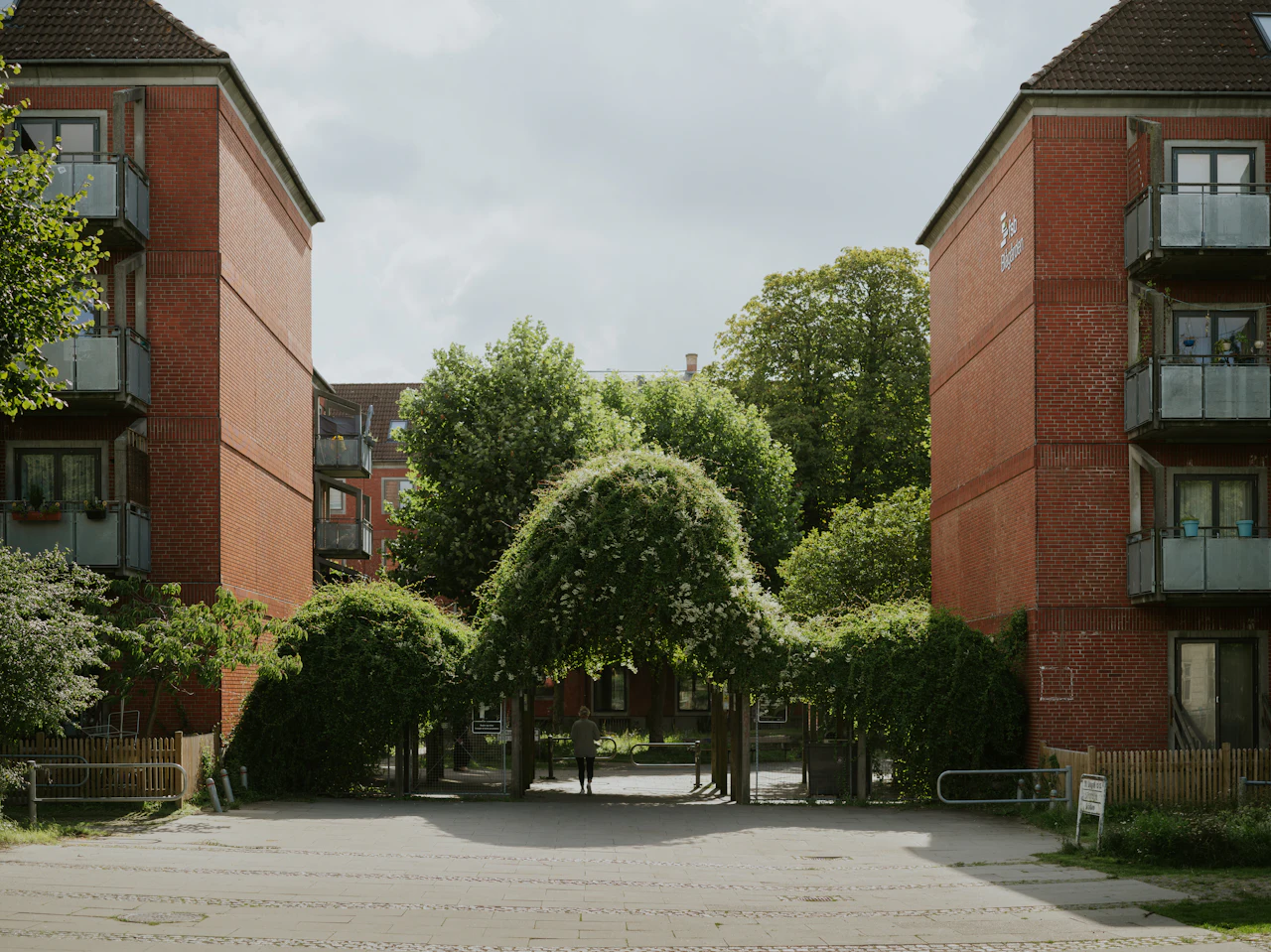
Almen bolig waiting list: How to sign up in Denmark
Updated October 2026. If you want to live in an almen bolig (Danish non-profit housing), the first step is almost always the same: you have to get on a waiting list. There is no single list for the whole of Denmark. You sign up with one or more boligorganisationer (non-profit housing associations) or on a shared waiting list in your area, and you pay a fee to stay on the list. How long you wait in total depends on the area, the type of home, how long you have been on the list and who has priority.
This is a practical guide to how the waiting lists work, what they typically cost, who goes first, and how to search the private rental market while you wait.
In short
- You can sign up once you have turned 15. That is why many parents sign their children up on their 15th birthday.
- You pay a fee to sign up and then an annual fee to stay on the list. If you don’t pay, you will normally be removed and lose your place (your anciennitet, or seniority).
- Vacant family homes normally go to whoever has been on the list longest. There are, however, several exceptions, which you can read about below.
- Residents who already live with the housing association have priority for every second vacant home through what is known as the oprykningsventeliste (internal transfer list).
- The municipality can claim up to one in four vacant family homes and use them for residents with an urgent housing need.
This means the wait can be considerably longer than your number on the list suggests.
What is an almen bolig?
An almen bolig, also called almennyttig bolig or simply a “boligforening”, is a rental home owned by a non-profit housing association. Nobody is allowed to make a profit on the rent, and residents have a say through the residents’ democracy (beboerdemokratiet) (Københavns Kommune: Find en almen bolig, in Danish). There are three main types:
- Familieboliger (family homes): The ordinary non-profit flat or terraced house. These are what this guide is mainly about.
- Ungdomsboliger (youth housing): For students and young people with a particular need. They often have their own waiting lists with their own rules.
- Ældreboliger (housing for older people): Homes for older people and people with disabilities, which are usually allocated according to need and not only seniority.
The rules on letting non-profit family homes are set out in the almenboligloven (the Danish Social Housing Act) and in the executive order on letting non-profit housing (bekendtgørelsen om udlejning af almene boliger). Housing associations do, however, have some freedom, for example to set fees and to choose whether they have active and passive lists. So always check the rules with the specific organisation.
Step by step: How to get on a waiting list
1. Find out who lets homes in your area
Start by finding out which non-profit housing associations have homes where you want to live. In many places, the associations have joined forces on a shared waiting list:
- Aarhus: Most non-profit housing associations in and around Aarhus use the shared waiting list AARHUSbolig. Aarhus Kommune points out, however, that not all non-profit homes in the municipality are let through AARHUSbolig (Aarhus Kommune: Søger du en familiebolig i en boligforening?, in Danish).
- Odense and Funen: Most housing associations in Odense have a shared waiting list via the portal BoligØen, where you can sign up from the age of 15. Not all associations take part (Odense Kommune: Sådan får du en almen bolig, in Danish).
- Copenhagen and the capital region: Here you generally have to contact the individual housing associations. Københavns Kommune has a list of them on its website. Some associations share a waiting list, for example KAB’s Bolignøglen, which covers homes belonging to several housing associations.
You can also use the portal DanmarkBolig, run by the non-profit housing associations, to see estates (afdelinger) all over the country and find out who to sign up with. If in doubt, contact your municipality’s department for non-profit housing.
2. Sign up and pay the registration fee
You usually register online with MitID (the Danish digital ID) and pay a registration fee. From that day, you start building up seniority. The fee is set by each housing association, but it must not substantially exceed the association’s costs of running the waiting list.
3. Remember the annual fee
On top of registration, you pay an annual fee (also called an ajourføringsgebyr) to stay on the list. If you don’t pay, the housing association must send you a reminder, and if you still don’t pay, you will be removed. If you sign up again later, you start from scratch without your old seniority. So set up the fee on Betalingsservice (the Danish direct debit system), and keep your address and email up to date.
4. Choose active or passive, if you can
Some waiting lists distinguish between active and passive home seekers. With AARHUSbolig, for example, you build up seniority while you are passive, but you only receive housing offers once you are active. If you are only on the list to secure a place for later, a passive registration can be cheaper. When you get close to the time you want to move, you switch to active.
5. Apply for specific estates and reply quickly to offers
Being on the list is not enough. You usually also have to choose the estates, home sizes and rent you are interested in. When you receive a housing offer, there is a deadline for replying. How long it is, and how many times you can say no before it has consequences, depends on the organisation. Read the offer carefully and reply before the deadline.
What does it cost to be on a waiting list?
There is no fixed nationwide rate. Here are examples from two of the large shared waiting lists, as shown on their own websites in October 2026:
| Waiting list | Registration | Annual fee |
|---|---|---|
| KAB, Bolignøglen (capital region) | DKK 250 | DKK 250 (DKK 280 if paying by card) |
| AARHUSbolig, passive | see the organisation | DKK 100 |
| AARHUSbolig, active | see the organisation | DKK 300 |
| AARHUSbolig, active plus (with help signing up and replying) | see the organisation | DKK 400 |
Fees can change, so always check the price before you sign up. With KAB, it is free to be on the waiting list for ungdomsboliger, kollegier (student halls of residence) and student housing.
Worked example: You live in Copenhagen and sign up for four different waiting lists, each costing DKK 250 to join and DKK 250 a year. In the first year, you pay 4 × DKK 500 = DKK 2,000. In the following years, you pay DKK 1,000 a year. Over ten years, that comes to about DKK 11,000. It may well be worth the money, but it is a good idea to choose waiting lists that actually cover the areas you want to live in.
Who gets the home first? Seniority, internal transfers and priority
This is where many people get a surprise. Your number on the list is only part of the picture.
The external waiting list: longest wait first
If you are on the list without living with the housing association, you are on the ordinary (external) waiting list. Here, homes normally go to whoever has been on the list longest.
The internal transfer list: residents have priority for every second home
If you already live in a non-profit home with the association, you can join the oprykningsventeliste, the internal list. Residents have priority for every second vacant family home before it passes to the external waiting list. With AARHUSbolig, you get resident priority once you have lived for at least a year in a home with one of the associations. Other requirements may apply elsewhere.
What this means in practice: Once you get a non-profit home, even one that isn’t your first choice, it may later be easier to move to a bigger or better located home within the same organisation.
Municipal allocation: up to one in four homes
The municipality can decide that the housing association must make up to one in four vacant non-profit family homes available to the municipality so it can deal with urgent social housing needs (almenboligloven § 59, in Danish). The housing association and the municipality can also agree on a larger share. If you are in an urgent situation yourself, contact your municipality (kommune).
Fleksibel udlejning and special criteria
The municipality and the housing association can agree that vacant homes in certain estates are to be let according to special criteria, for example to home seekers who are in work or in education. This is called fleksibel udlejning (flexible letting) (almenboligloven § 60, in Danish). Københavns Kommune, for example, says that you can move up the queue if you are in education or in permanent employment. The criteria vary from municipality to municipality and from estate to estate, and you must be able to document that you meet them.
Example: Why the wait can be longer than expected
Mikkel is number 40 on the list for a three-room flat in a popular estate. Over a year, five flats become vacant. Some of them go to residents on the internal transfer list, one may go to municipal allocation, and one goes to a home seeker with priority under flexible letting. Perhaps only one or two are left for the external waiting list, and some of the people ahead of Mikkel say yes. So his number only moves slowly. Many housing associations publish an expected waiting time for each estate, and that is a better guide than the number itself.
What does it cost to move into an almen bolig?
In a non-profit home, you usually pay a beboerindskud (a resident’s move-in deposit) when you move in, instead of the depositum (deposit) and forudbetalt leje (prepaid rent) you may know from private rentals. The amount depends on the home and is stated in the housing offer.
If you can’t pay the beboerindskud yourself, you can apply to your new municipality for a lån til beboerindskud (a loan for the move-in deposit). Herning Kommune, for example, states that the home must have been brought into use after 1 April 1964, that the municipality must generally grant the loan if the household’s income is below a certain limit, and that the loan is interest-free and repayment-free for the first five years (Herning Kommune: Indskud i almene boliger, in Danish). Income limits and terms are adjusted regularly, so check them with your own municipality.
Once you have moved in, you may also be entitled to boligstøtte (housing benefit). Read more about housing benefits.
How to combine the waiting list with the private rental market
For most people, the waiting list is a long-term plan, not a solution to an urgent housing need. That is why it is wise to work on two tracks:
- Track 1, long term: Stay on the relevant non-profit waiting lists, pay the fee and keep your preferences up to date.
- Track 2, here and now: Find a private rental, a room or a sublet that covers your needs while you wait.
What does a private rental cost while you wait?
Here are typical rents for flats on Bolighub in Denmark’s four largest cities. The figures are medians of the advertised rent in active listings on Bolighub, calculated on 22 October 2026:
| City | Flat, all sizes | 2-room flat |
|---|---|---|
| Copenhagen | DKK 15,525 | DKK 14,800 |
| Aarhus | DKK 9,995 | DKK 9,645 |
| Odense | DKK 8,610 | DKK 7,600 |
| Aalborg | DKK 7,208 | DKK 6,395 |
Rents are before utilities. You can see more figures on the rental market page. The figures show that it pays to assume a private option may be more expensive than the non-profit home you are waiting for, especially in Copenhagen. Make a budget that holds up, even if the wait drags on.
Choose a private lease that doesn’t tie you down for too long
When you rent privately while waiting for a non-profit home, you need to be able to move when the offer comes. Watch out for:
- Notice period: For a flat, the tenant’s notice period is normally 3 months, and for a single room 1 month, but something else may have been agreed in the special terms of the lease. Read § 11 of the contract.
- Uopsigelighed (non-terminable period): An agreement that you can’t give notice during the first 12 months can make it hard to accept a housing offer.
- Fixed-term leases (tidsbegrænsede lejemål): These end on a set date but normally can’t be terminated before then unless this has been agreed.
- Double rent: If you are offered a non-profit home at short notice, you may end up paying rent in two places for up to three months. Have a buffer.
Use search agents on both tracks
Keep an eye on new homes instead of checking manually every day. On Bolighub you can set up a search agent and get notified about new rental homes that match your area and budget. The non-profit waiting lists can usually also send you housing offers by email.
Examples: What a plan can look like
Sofie, 19, Aarhus. Sofie signed up for AARHUSbolig as a passive member when she was 15. Now she is studying and lives in a room. She switches to the active waiting list and chooses estates with two-room flats close to the university. She also checks whether any estates use flexible letting for students. She avoids signing a lease for a room with a long non-terminable period.
The Hansen family, Copenhagen. The family lives in a private three-room flat costing DKK 17,000 a month and would like a bigger non-profit home. They sign up for several waiting lists covering the parts of the city they could see themselves living in, and also choose estates a little outside the centre, where the wait is often shorter. Once they live in a non-profit home, they can later use the internal transfer list to move within the organisation.
Common mistakes
- Forgetting the annual fee. This is the most common way to lose many years of seniority.
- Signing up too late. You can sign up at 15, and seniority can’t be bought afterwards.
- Thinking your number equals your waiting time. Internal transfers, municipal allocation and priority rules mean the queue moves more slowly.
- Staying passive for too long. On some lists, you only receive offers as an active home seeker.
- Searching too narrowly. Only one popular estate can mean many years of waiting.
- Tying yourself to a private home with a long non-terminable period, so you can’t accept an offer.
- Forgetting to update your address and email, so reminders and housing offers don’t reach you.
Checklist for home seekers
- I know which housing associations and shared waiting lists cover the areas I want.
- I have signed up and paid the registration fee.
- The annual fee is set up on Betalingsservice.
- I have made a deliberate choice between the active and passive waiting list.
- My preferences for estate, size and rent are up to date.
- I have checked whether I can get priority under flexible letting.
- I know the beboerindskud and whether I can apply for a loan for it.
- My private lease lets me move out with reasonable notice.
- I have a financial buffer for a period of double rent.
Advice for private landlords
Many of the tenants who contact you are also on a non-profit waiting list. That is not a problem, but it is worth taking into account:
- Ask about the tenant’s plans at the viewing. A tenant who expects a housing offer within a year can still be a good tenant, but you get more realistic expectations.
- Only use a fixed term or a non-terminable period when you have a genuine reason. A fixed term must be justified by your circumstances as a landlord, or it may be set aside. A non-terminable period can also put off good tenants who are on a waiting list.
- Be ready to re-let. If your tenant gets a non-profit home, they will usually give notice according to the notice period in the lease. With a good listing and a set process for viewings, the property stands empty for less time.
- Set a realistic rent. Tenants compare with the non-profit rent they can eventually get. A rent that matches the standard of the home and the rules that apply to your property makes for more stable tenancies.
When should you contact the housing association or the municipality?
- The housing association: if you have been removed because a reminder didn’t reach you, if you are unsure about fees, or if you want to know the expected waiting time for a particular estate.
- The municipality: if you are without a home or about to lose your home and can’t solve the problem yourself, if you want to apply for a loan for the beboerindskud, or if you want to know the municipality’s rules on flexible letting.
- Advice: if you are unsure about a private lease, for example about notice or a non-terminable period, it pays to get a specific assessment before you sign.
Brief summary
Sign up for the non-profit waiting lists that cover the areas you want to live in as early as possible, ideally from the age of 15. Pay the annual fee on time, keep your preferences up to date, and remember that residents, municipal allocation and flexible letting mean the queue can move slowly. At the same time, search privately with a lease that lets you move when the offer comes, and make a budget that can hold until you get the non-profit home.
FAQ
How old do you have to be to sign up for an almen bolig?
You can sign up for the ordinary waiting list for non-profit family homes once you have turned 15. That is why many parents sign their children up on their 15th birthday, so they have built up seniority by the time they move away from home.
What does it cost to be on a waiting list for an almen bolig?
Each housing association sets its own fees. You typically pay a registration fee and an annual fee of a few hundred kroner per waiting list. With KAB’s Bolignøglen in 2026, it is DKK 250 to sign up and DKK 250 a year. With AARHUSbolig, an active waiting list costs DKK 300 a year and a passive one DKK 100 a year.
What happens if I forget to pay the annual fee?
The housing association must send you a reminder. If you still don’t pay, you will be removed from the waiting list and lose your seniority. You can sign up again, but then you start from scratch.
How long is the wait for an almen bolig?
It varies a lot, from a relatively short time in some areas to many years in popular estates in the big cities. Ask the housing association about the expected waiting time for the specific estates you are interested in.
Can I jump the queue?
In some cases, yes. If you already live in a non-profit home, you have priority for every second vacant home in the organisation via the internal transfer list (oprykningsventeliste). Many municipalities also use flexible letting, where, for example, people in work or in education have priority in certain estates. If you have an urgent housing problem, the municipality can allocate you a home.
Do I have to pay a depositum in an almen bolig?
In a non-profit home, you usually pay a beboerindskud instead of a depositum and forudbetalt leje. If you can’t pay it yourself, you can apply to the municipality for a loan for the beboerindskud if you meet the conditions.
Sources and further reading
- Retsinformation: Bekendtgørelse af lov om almene boliger m.v. (LBK nr. 207 af 25. januar 2026), especially § 51, § 59 and § 60 (in Danish)
- Retsinformation: Bekendtgørelse om udlejning af almene boliger m.v., on waiting lists, the age limit, fees and the internal transfer list (in Danish)
- Social- og Boligstyrelsen: Vejledning om udlejning af almene boliger (guidance on letting non-profit housing), July 2024
- Retsinformation: Lejeloven (the Danish Rent Act, in Danish)
- Københavns Kommune: Find en almen bolig i København (in Danish)
- Aarhus Kommune: Søger du en familiebolig i en boligforening? (in Danish)
- Odense Kommune: Sådan får du en almen bolig (in Danish)
- Herning Kommune: Indskud i almene boliger (in Danish)
- BL – Danmarks Almene Boliger: Regler om udlejning (rules on letting)
- KAB: Priser og gebyrer for ventelister (waiting list prices and fees)
- AAB Aarhus: Sådan kommer du på ventelisten (AARHUSbolig) (how to get on the waiting list)
- Bolighub: rent figures from active listings, calculated 22 October 2026