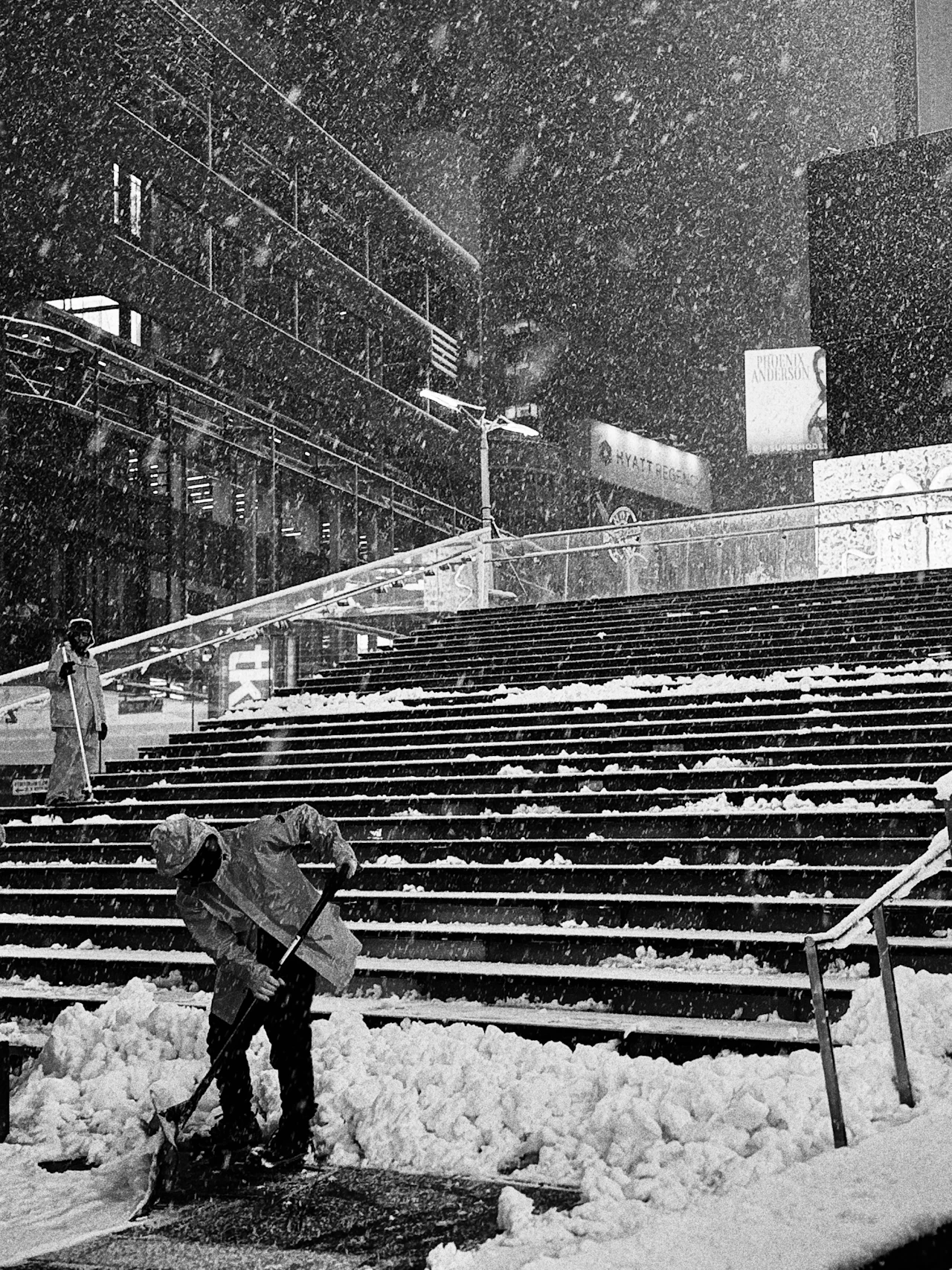
Snow Clearing in Denmark: Rules for Tenants and Landlords
Updated November 2026. The first snow has fallen, and the pavement outside your home is slippery. Should you get the shovel out yourself, or is it a job for the landlord, the caretaker or the local council? And who is liable if the postman slips on the ice at 8 in the morning?
The answer depends on three things: what the Danish roads act (vejloven) says about property owners’ duties, what your municipality has decided in its winter regulations (vinterregulativ), and what your lease says if you rent. Here the rules are explained simply, with examples, a checklist and practical advice for both tenants and landlords.
In short
- The property owner has the duty towards the municipality. In towns and built-up areas, the property owner must always clear snow and deal with slippery conditions on the steps leading to the property (section 63 of vejloven).
- The pavement and path in front of the property must be cleared by the property owner if the municipality has decided so. The duty covers a pavement or path area no more than 10 metres wide (section 64). The vast majority of urban municipalities have decided this.
- On a private communal road (privat fællesvej), the property owners usually also have to clear and salt the road itself, as a general rule out to the middle of the road.
- It must be done as soon as possible after snowfall or when it becomes slippery (sections 66 and 67). Municipalities typically expect the pavement to be passable from the morning until 22:00.
- In a rental home, the starting point is that the landlord takes care of snow clearing. It can be agreed that the tenant does it, but the agreement should be clearly written in section 11 of the lease on special terms.
- If someone falls, whoever neglected the duty can be held liable for damages. This typically requires that the duty was neglected, not merely that it was slippery.
Who has the duty? The property owner first
The rules on property owners’ winter duties are found in chapter 8 of the Act on Public Roads (lov om offentlige veje, known as vejloven). The old “winter act” (vinterloven) on winter maintenance and cleaning of roads was repealed when the current vejlov came into force in 2015. Many older articles and house rules still refer to it, so check that you are reading the rules that apply today.
Property owner (grundejer) means the owner of the property. In a rental home, that is the landlord, not the tenant. This matters because the municipality directs its requirements at the owner.
Steps: always the property owner’s duty
In towns and built-up areas, the property owner must always clear snow, deal with slippery conditions and keep the steps leading to the property clean (section 63 of vejloven). This applies regardless of what else the municipality has decided.
Pavement and path: when the municipality has decided so
The municipality (as road authority) can, after consulting the police, decide that property owners along a public road or path must clear snow, salt or grit, and clean the pavement and path in front of their property (section 64(1)). The law sets some limits:
- The duty covers pavement or path that lies in direct continuation of an access to the property (section 64(2)).
- It can cover a pavement or path area of no more than 10 metres in width, and only the area closest to the property.
- The municipality must publish its decision and can issue more detailed instructions, for example on which products you may use (sections 64(4) and 65).
The duty means that the pavement must be cleared of snow as soon as possible after snowfall (section 66), and that action must be taken against slippery conditions as soon as possible after it has become slippery (section 67). Property owners must also always keep the area around fire hydrants, fire and police alarm boxes and traffic control installations clear of snow (section 66(2)).
Private communal roads: the road surface too
If you live on a private communal road (privat fællesvej), the municipality is not responsible for clearing the road. Under the Act on Private Communal Roads (privatvejsloven), the property owners along the road are. Københavns Kommune (the City of Copenhagen) writes that the duty covers the entire traffic area in front of the property, and as a general rule out to the middle of the road. Lyngby-Taarbæk Kommune also mentions cycle paths on private communal roads.
Many roads handle this through a homeowners’ association (grundejerforening) or a road association (vejlaug), which hires a contractor for the whole road. According to Lyngby-Taarbæk Kommune, however, not being a member of the association does not release you from the duty. You can usually find out whether your road is public or a private communal road on the municipality’s website or by asking its roads department.
What does the municipality require in practice?
Vejloven says “as soon as possible”. It is the municipalities’ regulations and case law that make the requirements concrete, and they vary. Here are three examples from the municipalities’ own websites:
| Requirement | Copenhagen | Aarhus | Kolding |
|---|---|---|---|
| Which areas | Pavement, path and outdoor steps in front of the property | Pavement and path, entrances and steps, access to letterbox and bins | Pavement and walkway in front of the property |
| Width | The full width of the pavement in front of the property, at least 1.5 metres | Not stated on the municipality’s website | Not stated on the municipality’s website |
| When | As a rule, cleared from 6:00 to 22:00, also when you are away | Good practice to clear and salt in the morning before traffic starts | Case law normally requires the pavement to be cleared from 7:00 to 22:00 |
| Snow banks left by the municipality’s snowplough | Make a passage through | Not mentioned | The property owner’s responsibility to dig a passage |
The municipalities also agree on the following:
- Icicles and snow on the roof that could fall on passers-by must be removed by the property owner. Copenhagen writes that the area must be cordoned off until this has been done. Aarhus says the same.
- Salt, grit or something else. Aarhus accepts salt, grit, bark and soil, but you must sweep it up again afterwards. Kolding points out that salt can damage plants and does not always work in hard frost, when grit gives better grip. Copenhagen recommends taking care of trees and plants.
- Don’t put the snow in front of gates and driveways, at street corners, pedestrian crossings or bus stops, and keep fire hydrants clear.
- If you are on holiday or ill, you must arrange for someone else to do it.
Find your own municipality’s winter regulations on its website, usually under “vej og trafik” (roads and traffic) or “snerydning” (snow clearing).
What happens if you don’t clear the snow?
The municipality supervises and can, if necessary, have the work done at the property owner’s expense (section 69 of vejloven). Kolding Kommune writes that this happens after a warning and an order, and that you can also be reported to the police and fined, whether or not an accident has happened. The biggest financial risk, though, is often liability for damages if someone gets hurt.
Snow clearing in a rental home: tenant or landlord?
Vejloven refers to the property owner, and it contains no rule saying that the duty towards the municipality passes to a tenant. Between tenant and landlord, however, it is the lease that decides who actually picks up the shovel.
The starting point: the landlord
If nothing has been agreed, clearing snow and salting access routes is part of the landlord’s exterior maintenance and running of the property. In a block of flats, it is typically the caretaker (vicevært) or a company that clears the snow, and the cost is part of the property’s running costs and therefore included in the rent. Read more about how tasks are divided in our guide to maintenance and repairs in a rental.
It can be agreed that the tenant clears the snow
When houses and terraced houses are let, it is common for the tenant to handle snow clearing in front of their own home. Such an agreement gives the tenant more duties than the legal starting point, so it should be written into section 11 on special terms of the standard lease form typeformular A10. Read more in our guide to typeformular A10.
Be aware that the Danish Rent Act (lejeloven) limits how much exterior maintenance can be passed on to the tenant in certain properties in municipalities with rent regulation (boligregulering) (section 115(2) of lejeloven). It is not clear-cut whether snow clearing counts as exterior maintenance in that context. If you live in a larger rental property in a regulated municipality and your lease says you must clear snow, have it assessed by a tenants’ association (lejerforening) or a lawyer if it becomes a problem.
What a clear term can look like
A vague term such as “the tenant is responsible for snow clearing” leaves room for disagreement. A better example:
The tenant clears snow and treats slippery conditions on the pavement in front of the property, the garden path up to the front door and the steps, so that they are passable during the hours required by the municipality’s winter regulations. The tenant arranges cover during holidays and illness. The landlord provides a snow shovel and grit and is responsible for removing icicles and snow from the roof.
The good term describes which areas, when, who provides tools and salt, and what the landlord takes care of. The roof and icicles are a job that requires a ladder and can be dangerous, so as a rule the landlord should keep it.
How many rental homes are houses and terraced houses?
Snow clearing is mostly an issue when you rent a house or terraced house with its own entrance. According to listings on Bolighub, counted on 19 November 2026, around one in five rental homes is a terraced house or house, while about 8 in 10 are flats. See more figures on the rental market, or find terraced houses for rent. Always ask the landlord about snow clearing before you sign.
Who pays if someone falls?
If a pedestrian slips on a pavement that has not been cleared, whoever neglected their duty can be held liable for damages. Københavns Kommune states plainly that the property owner can be held liable for accidents caused by slippery conditions, and that any claim for damages is a matter between the property owner and the injured person.
Liability generally requires fault, meaning the duty was actually neglected. It is not enough that it was slippery. Lyngby-Taarbæk Kommune writes that case law does not make anyone liable for snow that has not been cleared during the night, and that the courts assess each case individually. Kolding Kommune refers to case law normally requiring the pavement to be cleared from 7:00 to 22:00.
When the tenant has taken over the duty
If the tenant has taken on snow clearing in the lease and neglects it, the tenant may risk being liable, and the landlord may face a claim from the injured person because the landlord is the property owner. How liability is shared depends on the agreement and the specific case, and the sources do not agree. The safe advice for both parties is to document what has been done and to check the insurance.
Check the insurance
- Landlord/property owner: Check that the property’s insurance includes liability cover for damage to third parties, for example accidents caused by slippery conditions.
- Tenant: Ask your insurer whether the liability cover in your contents insurance (indboforsikring) applies when you have taken over snow clearing by agreement with the landlord. It is not a given.
- If you use a snow-clearing company, read the contract. According to Lyngby-Taarbæk Kommune, the property owner may be able to pass a claim on to the company, depending on the terms of the agreement.
Three everyday examples
Terraced house in Odense. Amalie rents a terraced house. Section 11 says she must clear snow on the pavement and the garden path. One January morning it has snowed overnight, and she shovels and grits at 7:00 before cycling to work. She has done what can be expected. If it becomes slippery again during the day, she, or a neighbour she has arranged it with, must grit again.
Flat in Aarhus. Jonas lives on the 3rd floor of a block of flats. His lease says nothing about snow. The pavement has not been cleared after two days of snow. Jonas does not have to clear it himself, but he should write to the landlord or the property administrator and ask them to deal with it. If there is a risk of someone getting hurt, he can also report it to the municipality.
House on a private communal road. Søren lets a house on a residential street that is a private communal road. Under the lease, the tenant handles snow clearing on the pavement, but nobody has discussed the road itself. The property owners also have to clear the road out to the middle. Søren chooses to pay his share to the road association’s contractor and adds an addendum to the lease stating that the tenant is only responsible for the pavement, steps and garden path.
Checklist for tenants
- Does your lease say anything about snow clearing and salting, and if so, is it in section 11?
- Which areas does your duty cover: steps, garden path, pavement, parking space, road?
- Is the home on a public road or a private communal road?
- Who provides the snow shovel, grit or salt?
- Who removes icicles and snow from the roof?
- Have you arranged cover for when you are on holiday or ill?
- Does your contents insurance cover you if you have taken over the duty?
- Do you keep documentation, such as time-stamped photos, after clearing heavy snowfall?
Advice for landlords
- Decide who clears the snow before the tenant moves in, and write it specifically in section 11. Without an agreement, it is generally you.
- Remember that the duty towards the municipality is yours. Follow up if the tenant doesn’t clear the snow, and give written notice with a short deadline.
- Keep the roof and icicles for yourself, or have a professional do it.
- Provide tools and grit if the tenant is to clear the snow. That removes a common excuse.
- Check the insurance and any agreements with a snow-clearing company or road association.
- Know the municipality’s requirements. Width, hours and rules on salt vary from municipality to municipality.
- Keep the house rules up to date. If they refer to the old winter act, correct them. See our guide to house rules in a rental.
Common mistakes
- Waiting until it has stopped snowing. The law says as soon as possible after snowfall, and Kolding Kommune writes that you should not wait until the snow has stopped.
- Forgetting the snow bank left by the municipality’s snowplough. A passage must be made.
- Pushing the snow out onto the road, in front of a driveway or on top of a fire hydrant.
- Thinking that being on holiday excuses you. You must arrange for someone else to clear the snow.
- The tenant and landlord have a verbal agreement. When an accident happens, it is hard to prove who had the duty.
- The term is too vague. “The tenant clears snow” says nothing about the roof, the road, tools or times.
Owner-occupied flats, co-op housing and social housing
In an owners’ association (ejerforening) or a housing co-operative (andelsboligforening), it is usually the association that organises snow clearing of the pavement and shared areas, for example through a caretaker or a company. However, the articles of association and house rules can place tasks on individual residents, especially in terraced housing developments. In social housing (almen bolig), the section’s house rules or maintenance regulations decide whether you have to clear snow in front of your own home. Ask the board or the housing organisation if you are unsure.
When should you contact someone?
- Landlord or property administrator: when the pavement, steps or courtyard are not being cleared and it is the landlord’s job. Write by email so you have documentation.
- The municipality: when a public pavement is not being cleared, or when you are unsure which requirements apply. Many municipalities have a digital service for reporting problems on the road.
- Huslejenævnet (the local rent tribunal): when tenant and landlord disagree about how maintenance duties are divided under the lease.
- Your insurer: immediately if someone has been injured or you receive a claim for damages.
- Tenants’ association, landlords’ association or a lawyer: if there is a claim for damages, or if you are unsure whether a snow-clearing term is valid.
If your home also has a garden, you can read about looking after the garden, hedge and pavement in our guide to renting a home with a garden.
Summary
The property owner has the duty towards the municipality: always for the steps, and for the pavement and path when the municipality has decided so, which most urban municipalities have. On private communal roads, the property owners must also clear the road surface. Clear snow as soon as possible, and check your municipality’s winter regulations for width and hours. If you rent, it is generally the landlord’s job unless section 11 of the lease clearly says otherwise. Put the agreement in writing, arrange cover for holidays, and check the insurance before winter really sets in.
FAQ
Who has to clear snow in front of a rental home?
Towards the municipality, it is the property owner, meaning the landlord. Between tenant and landlord, the lease decides. If it says nothing, it is generally the landlord. If the tenant has taken on the task, it should be clearly stated in section 11 of the lease.
What time of day does the pavement have to be cleared?
Vejloven says as soon as possible after snowfall or slippery conditions. Municipalities give different hours. Copenhagen says 6:00 to 22:00, and Kolding refers to case law normally requiring the pavement to be cleared from 7:00 to 22:00. Check your own municipality’s winter regulations.
How much of the pavement do I have to clear?
It depends on the municipality. Vejloven sets an upper limit of 10 metres in width. Copenhagen requires the full width of the pavement in front of the property, but at least 1.5 metres. The duty covers the pavement and path in front of an access to the property.
Do I have to clear snow when I’m on holiday?
Yes. If the duty is yours, you must arrange for someone else to do it while you are away. This applies both to property owners and to tenants who have taken over the task in their lease. Arrange it with a neighbour or a company in good time.
Who pays if someone falls on a slippery pavement?
Whoever neglected their duty can be held liable for damages. This generally requires that the duty was actually neglected. Slippery conditions during the night do not normally lead to liability. Property owners should have liability insurance, and tenants with a snow-clearing duty should ask their insurer whether they are covered.
Do I have to clear the road if I live on a private communal road?
Usually, yes. On private communal roads, the municipality does not clear the road, and the property owners must take care of both the pavement and the road surface, typically out to the middle of the road in front of their own plot. Many roads have a road association or homeowners’ association that organises it.
Sources and further reading
All external sources are in Danish.
- Retsinformation: Lov om offentlige veje m.v., LBK nr. 435 af 24. april 2024, chapter 8, especially sections 62-69
- Retsinformation: Lov om private fællesveje, LBK nr. 1050 af 17. september 2024
- Retsinformation: Lejeloven, lov nr. 341 af 22. marts 2022 with later amendments, especially section 115
- Københavns Kommune: Her skal du salte og rydde sne (where you must salt and clear snow)
- Københavns Kommune: Grundejers ansvar for vej og fortov (property owners’ responsibility for road and pavement)
- Aarhus Kommune: Dit ansvar for snerydning og saltning (your responsibility for snow clearing and salting)
- Kolding Kommune: Ofte stillede spørgsmål om snerydning (FAQ on snow clearing)
- Lyngby-Taarbæk Kommune: Private fællesveje (private communal roads)
- Bolighub: shares of property types from listings on Bolighub, counted on 19 November 2026, see rental market