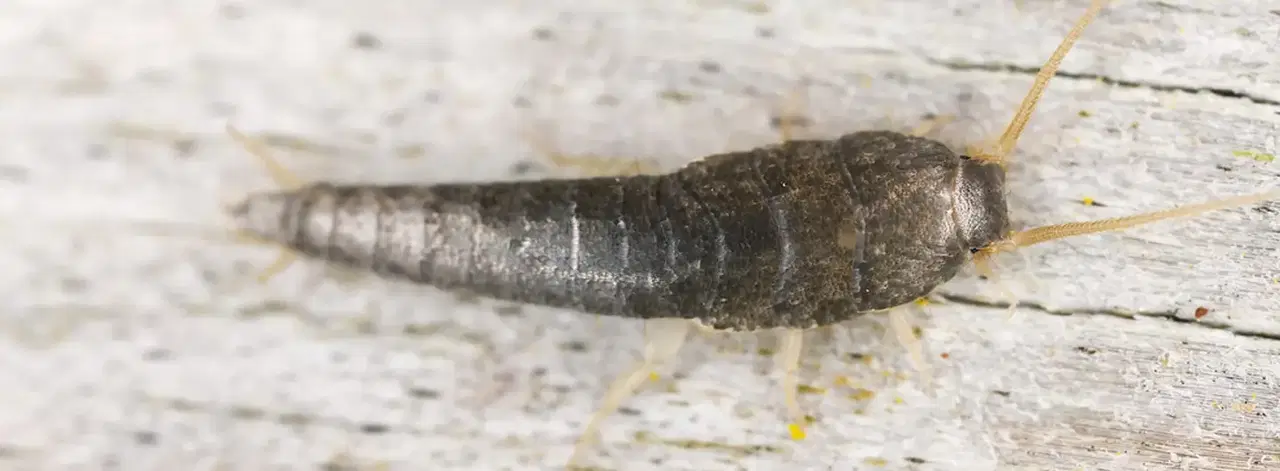
Grey silverfish and silverfish: How to get rid of them
If you see small grey insects darting across the kitchen floor in the evening, the first question is not which poison to buy. It is whether they are common silverfish or grey silverfish, known in Danish as skægkræ. The two look alike, but they live differently, and what works against silverfish is not enough against grey silverfish.
Here is the difference, an honest answer to whether they are harmful, what works, and what to do as a tenant.
In brief
- Silverfish (sølvfisk) thrive in damp places and are kept down with less damp and vacuuming.
- Grey silverfish (skægkræ, also called skægget sølvkræ or long-tailed silverfish) are larger, can live in dry rooms and climb walls. A dehumidifier is not enough here.
- Neither of them bites or is poisonous. The problem is the nuisance and damage to paper, cardboard and dry food.
- If you rent, a larger grey silverfish infestation often needs a joint effort across the building. Tell your landlord in writing.
Silverfish or grey silverfish? How to tell them apart
| Feature | Silverfish | Grey silverfish |
|---|---|---|
| Size | About 10-12 mm | Up to about 18 mm |
| Colour | Silvery, bluish or grey | Darker and more matt, grey-brown |
| Hairs and tails | Short tail filaments | Clear bristles on the head and long tail filaments |
| Damp | Thrive best where it is damp | Also cope in dry rooms |
| Climbs walls | Rarely | Yes, also into cupboards and shelves |
| Typical places | Bathroom, kitchen, basement | The whole home, including living room, bedroom and bookshelves |
Source for size, appearance and habitat: Miljøstyrelsen (the Danish Environmental Protection Agency) on insects in the home (in Danish).
Small, young grey silverfish can be hard to tell from silverfish. A good practical sign is where you find them. If there are grey insects on the living room wall, in a bookcase or high up inside a kitchen cupboard, grey silverfish are the most likely. If you only see them on the bathroom floor, it is more often silverfish.
The difference matters because silverfish depend on damp. If you get the damp under control, you usually get the silverfish under control. Grey silverfish cope in dry rooms and move between flats, so a dehumidifier is not enough.
Why are more people seeing grey silverfish?
Grey silverfish are a fairly new species in Denmark. According to Danish researchers, they were first recorded here in 2017, and a survey YouGov carried out for Videncentret Bolius, a Danish housing advice centre, in 2023 found that 14 percent had seen grey silverfish in their home.
The most commonly mentioned ways they spread are:
- Cardboard and parcels. Miljøstyrelsen writes that grey silverfish can hide in cardboard packaging and come in that way.
- Moving boxes and second-hand furniture. The insects can travel from home to home.
- Inside the building. Grey silverfish can move between flats along pipes, cables, cracks and shared service shafts.
Grey silverfish are found in both older and newer buildings. Older buildings have more cracks to hide in, but shared shafts and cardboard in basement storage rooms also give good conditions in newer buildings. A new building is no guarantee.
Are silverfish and grey silverfish dangerous?
The honest answer is no, not to your health. Miljøstyrelsen describes silverfish as mostly quite harmless, and grey silverfish as insects that normally only do minor damage. They don’t bite, they are not poisonous, and Danish insect researchers point out that they are not known to spread disease. There may be a small risk that they contaminate open food, which is a good reason to store dry food in sealed containers.
The damage is to things: paper, books, photos, wallpaper, cardboard boxes, textiles and open dry food such as flour and oats. For most people, the biggest problem is that it is unpleasant. That is a fair reason to act, but not to spray the whole home with poison.
How to get rid of silverfish
Silverfish are the easier problem to solve, because they depend on damp.
- Lower the damp. Air out with a through-draught several times a day, and use the cooker hood and ventilation when you cook and shower. Read more about airing out your home and damp.
- Dry the floors after washing them. Miljøstyrelsen recommends drying well afterwards, and using the vacuum cleaner rather than washing the floor where that makes sense.
- Vacuum cracks and gaps. Skirting boards, drawers, cupboard floors and behind the fridge and cooker are important places.
- Remove food. Crumbs, dust and hair are food for silverfish.
- For larger infestations. Only use a product approved for sale and use in Denmark against silverfish or crawling insects. Follow the label closely.
If the silverfish keep coming back in the bathroom even though you air out, it can be a sign of a damp problem, such as a leaking joint, a leaking pipe or poor ventilation. That is something you should tell your landlord about.
How to deal with grey silverfish
Grey silverfish take more patience. Eggs can hatch for weeks after the adults are gone, so expect it to take months, not days.
What you can do yourself
- Vacuum thoroughly and often, especially along skirting boards and in drawers, cupboards and gaps. Miljøstyrelsen recommends changing the vacuum bag or freezing it for a couple of days if you want to be sure the insects don’t survive.
- Unpack parcels outside, and put the cardboard box straight in the bin. Don’t keep piles of cardboard, newspapers or paper bags in the home or in the basement storage room.
- Keep dry food in airtight containers, such as flour, oats, rice and breakfast cereal.
- Seal gaps at skirting boards and around pipes with sealant where you are allowed to. For bigger jobs, ask the landlord first.
- Use sticky traps with bait, which Miljøstyrelsen mentions for smaller infestations. Put them along walls in several rooms, and write down how many you catch and where. That shows whether the problem is growing, and gives you documentation for the landlord. Norwegian trials have shown, however, that even many traps do not by themselves bring the population down, so use them for monitoring.
Poison gel and professional pest control
The method that has shown the best effect in trials is bait poison in gel form, placed in small drops along walls and in cracks. Over a few months it can reduce the population markedly. Professionals typically use sticky traps to locate the problem and gel or bait stations to fight it.
If you want to use a product yourself, Miljøstyrelsen’s advice applies:
- Only buy products approved for sale and use in Denmark, specifically against grey silverfish or crawling insects.
- Look for a Danish label with a registration number. You can look up the product in Miljøstyrelsen’s pesticide database (Bekæmpelsesmiddeldatabasen, BMD) (in Danish).
- Follow the instructions exactly, and place poison out of reach of children and pets.
Several researchers advise private households against spraying insecticides widely in the home. It can be a health risk and make the insects resistant to the poison.
Silverfish in the kitchen
The kitchen has both food and damp, so this is where many people discover the problem.
- Wipe the worktop and sink in the evening, and don’t leave wet dishcloths lying around.
- Pull out the fridge and cooker now and then, and vacuum behind and under them. Vacuum drawers and cupboard floors too.
- Keep an eye on damp under the sink. A small leak can keep the silverfish alive.
- Store dry food in containers with lids, and throw out open packets if there are insects in them.
- If you have grey silverfish, check the wall cupboards as well.
Silverfish in the bathroom
The bathroom is the silverfish’s classic home. Squeegee the water off the floor after a shower, and air out. Keep an eye on cracked joints and damp corners. If the ventilation doesn’t work, ask the landlord to have it checked.
As a tenant: what do you do, and who pays?
The Danish Rent Act, lejeloven, has no specific rule on silverfish or grey silverfish. The answer therefore depends on the general rules on the condition of the home, and on how big the problem is.
The landlord’s duties. The landlord must provide the home in good and proper condition (lejeloven § 89, in Danish) and keep the building and the rented home in proper repair (§ 112(2)). If the home is not in the condition you can demand, it is a defect (mangel). If the landlord does not remedy the defect after a demand, you can as a rule remedy it yourself at the landlord’s expense and claim a proportional rent reduction for as long as the defect reduces the home’s value to you (§ 95).
Are pests a defect? It depends on the specific circumstances. A few silverfish in a bathroom are unlikely to be a defect. A large grey silverfish infestation that spreads through the building and can only be solved jointly is something else, and so are silverfish caused by a leaking installation. If the problem is instead caused by you storing food openly or filling the home with cardboard, the landlord may have a good objection. There is no fixed rule on who pays for pest control, so agree it in writing before a pest controller is booked.
What to do in practice:
- Write to the landlord straight away, with photos and counts from the sticky traps. You must report damage to the rented home without undue delay (§ 149(3)). An insect infestation is not necessarily damage in the legal sense, but a quick written message is your best protection.
- Ask your neighbours whether they see the insects too. That shows whether a joint treatment is needed.
- Give access when the landlord or a pest controller needs to come in. The landlord has the right to access the home when circumstances require it (§ 102).
- Don’t book a pest controller yourself and send the bill to the landlord afterwards without an agreement. The right to remedy a defect yourself at the landlord’s expense requires that the landlord has first received a demand and has not acted.
- If you can’t agree, Huslejenævnet, the local rent tribunal, can as a rule decide whether the landlord has met the maintenance duty (§ 114). According to borger.dk (in Danish), cases about rent reductions because of defects belong in boligretten, the housing court.
Read our guide to maintenance and repairs in a rental home too. If you live in an almen bolig (non-profit social housing), contact the estate office or the housing organisation, which typically coordinates pest control on the estate.
When moving in and moving out
If you see silverfish or grey silverfish in the first few days, put it on your list of defects. If the home has defects when the tenancy begins, you must tell the landlord no later than 2 weeks after the tenancy begins so you don’t lose the right to claim the defect (§ 91). Take photos of skirting boards, cupboards and the bathroom.
Keep your messages to the landlord for when you move out, in case there is doubt about when the problem started.
At a viewing: signs to look for
- Dead insects on window sills and in drawers and cupboards
- Sticky traps along the skirting boards
- Damp, mould or poor ventilation in the bathroom and kitchen
- Lots of cardboard boxes in the basement or storage room
Ask directly whether there have been grey silverfish in the building and whether they have been treated, also in a new-build rental apartment. When you are looking at rental homes, it is a fair question.
Advice for tenants
- Find out whether it is silverfish or grey silverfish before you buy anything.
- Measure the problem with sticky traps, and write down the results.
- Tell the landlord in writing if it is more than a few insects, or if your neighbours have the same problem.
- Only use approved products with a Danish label, and follow the label.
Advice for landlords
- Take reports of grey silverfish seriously. An infestation left to grow becomes more expensive to solve.
- Coordinate treatment for the whole stairwell or building with a professional pest controller, and give tenants notice in good time.
- Keep basement storage, lofts and bin rooms free of old cardboard boxes.
- Check ventilation and damp in bathrooms if tenants report silverfish.
Common mistakes
- Thinking it is only a cleaning problem. Grey silverfish can be found in clean homes.
- Buying a dehumidifier against grey silverfish. It helps against silverfish, not grey silverfish.
- Spraying poison throughout the home. It gives more risk than results.
- Treating one flat when the whole building has the problem. The insects come back from the neighbours.
- Stopping after two weeks. New insects hatch, and it starts all over again.
- Waiting to tell the landlord. The earlier, the easier it is to solve and document.
In short
First find out whether you have silverfish or grey silverfish. You can usually keep silverfish down with less damp and vacuuming. Grey silverfish take patience: vacuuming, sealed containers, no cardboard, sticky traps for monitoring and, for larger infestations, approved bait poison or a professional. If you rent, write to the landlord with photos and counts, because an infestation in a building is best solved jointly.
FAQ
How do you get rid of silverfish?
Lower the damp by airing out, dry the floors after washing them, and vacuum cracks and gaps. For larger infestations, you can use a product approved in Denmark. If they come back, check for hidden damp.
What is the difference between silverfish and grey silverfish?
Grey silverfish are larger, up to about 18 mm, darker and hairier. They can live in dry rooms and climb walls. Silverfish are smaller, silvery and live where it is damp.
Are silverfish dangerous?
No. They don’t bite and are not poisonous. They can damage paper and textiles, but according to Miljøstyrelsen a small population is quite harmless.
Why do I have silverfish in the kitchen?
Typical causes are damp under the sink, crumbs behind appliances and open dry food. If there are also insects high up in the cupboards, they may be grey silverfish.
Does a dehumidifier help against grey silverfish?
Not on its own, because grey silverfish cope in dry rooms. A dehumidifier helps against silverfish, but grey silverfish need cleaning, less cardboard and often bait poison.
Does the landlord have to pay for grey silverfish control?
It depends on the case. If the infestation is so large that the home is not in proper condition, or it is caused by conditions in the building, it can be a defect the landlord must remedy. Agree on payment in writing before help is booked.
Sources and further reading
All sources are in Danish.
- Miljøstyrelsen: Insekter i hjemmet, herunder sølvfisk og skægget sølvkræ
- Miljøstyrelsen: Bekæmpelsesmiddeldatabasen (BMD)
- Retsinformation: Lejeloven, lov nr. 341 af 22. marts 2022 with later amendments, in particular §§ 89, 91, 95, 102, 112, 114 and 149
- Borger.dk: Beboerklagenævn og Huslejenævn
- Research on traps and bait poison from the Norwegian Institute of Public Health (Folkehelseinstituttet) and comments from Statens Naturhistoriske Museum (the Natural History Museum of Denmark), as reported by Videnskab.dk and Videncentret Bolius.