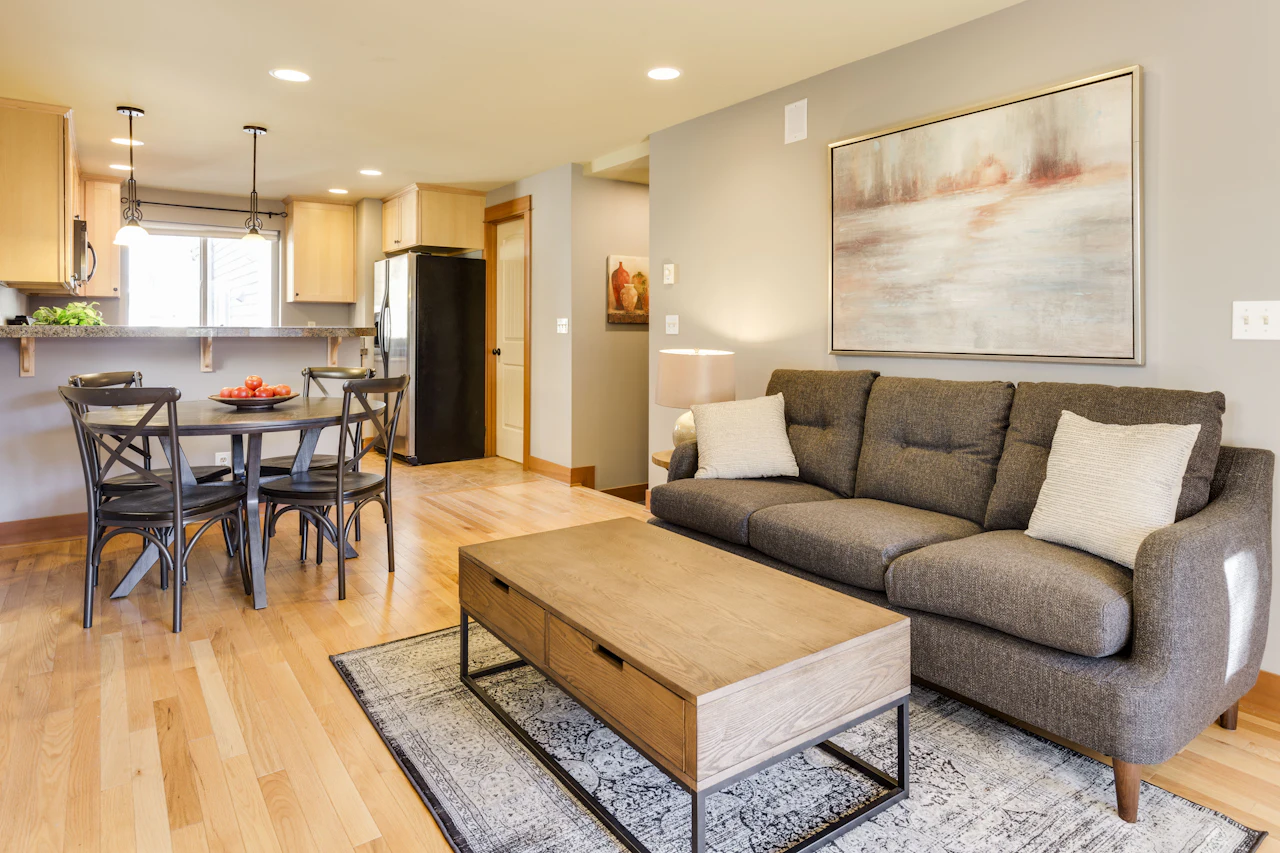
Furnished apartment for rent in Denmark: Rules and checklist
Updated October 2026. A furnished apartment is ideal if you need to move quickly, will only live somewhere for a limited period or are arriving from abroad without your belongings. But the furniture does not turn the tenancy into a special arrangement with no rules. The Danish Rent Act (lejeloven) applies in full, and the furniture does not give the landlord the right to demand whatever they like in rent or deposit.
In this guide we explain what this means for the rent, the depositum (deposit) and the lease, and what you should check before you sign. At the end there is advice for private landlords who want to rent out a furnished home.
In short
- The Rent Act also applies to furnished apartments and rooms. Holiday lets and hotel stays are, as a starting point, exempt.
- The law sets no fixed rate for how much more a furnished home may cost. Furniture and equipment are part of the overall assessment of whether the rent is lawful.
- The depositum and the forudbetalt leje (prepaid rent) may each be no more than 3 months’ rent, including when the home is furnished.
- Get an inventory list with photos attached to the lease. It is your most important evidence when you move out.
- Many furnished tenancies are time-limited. A time limit must be justified by the landlord’s circumstances.
Does the Rent Act apply to a furnished apartment?
Yes. The Rent Act (lejeloven, in Danish) applies to the rental, including subletting, of a house or premises (section 1(1)). There is no exemption for furnished homes. You therefore have the same basic rights as in an unfurnished apartment, for example the rules on deposits, the move-in inspection (indflytningssyn), termination and Huslejenævnet, the local rent tribunal.
As a starting point, however, the law does not apply to agreements for housing with full board, to hotels’ agreements with guests or to certain homes rented out for holiday and leisure purposes (section 1(3)). An apartment you rent for a week’s holiday through a rental platform is therefore something different from a furnished apartment you live in while you work or study in the city.
It also matters who you are renting from:
| Situation | What to pay particular attention to |
|---|---|
| An owner rents out their own apartment furnished, for example while living abroad | Often time-limited. The landlord can have the rent pre-approved by Huslejenævnet. |
| A tenant sublets their apartment furnished | You are renting from a tenant, not from the owner. The sublease must be in writing, and the original landlord must receive a copy. |
| A furnished room in the landlord’s own home | The landlord can terminate with shorter notice, and some rules on rent regulation do not apply. |
| An apartment in a rental property that is let furnished | The ordinary rules for the property apply, and the furniture must be included in the assessment of the rent. |
If you rent a room in the landlord’s own apartment, or in a one- or two-family house where the landlord lives, the landlord can terminate your tenancy (Rent Act section 170, no. 1), and the notice period is 1 month (section 175). For an ordinary termination, the notice period is 3 months.
Can a furnished apartment cost more?
Often yes, but not without limit. The Rent Act has no special rule or rate for a furniture surcharge. The rent must follow the ordinary rules on rent levels, and which rules apply depends on, among other things, where the home is located and when the property was first taken into use:
- In municipalities with rent regulation (huslejeregulering), the rent is as a rule assessed on the basis of the property’s costs or by comparison with similar tenancies. This depends on the size of the property. In smaller properties, the rent must not substantially exceed the rent for similar tenancies (section 32).
- In municipalities without rent regulation, the rent must not be substantially higher than the value of the rented property (det lejedes værdi), meaning the level paid for comparable homes in the area. Otherwise you can demand a rent reduction (section 45(1)). The case must be brought within 1 year of the date the rent first had to be paid (section 45(4)).
- In properties taken into use after 31 December 1991, the rent for residential apartments can, as a starting point, be agreed freely (section 54(1), no. 1).
So furniture and equipment can make a home worth more, but the surcharge must be defensible if the rent is challenged. How much the furniture can count depends on a specific assessment of quantity, quality and condition. There is no official rate, and you should be sceptical of listings claiming that a particular surcharge is always allowed.
If you think the rent is too high, you can ask Huslejenævnet to rule on it. The deadlines and rules depend on whether the municipality has rent regulation, so check your own situation soon after moving in.
Worked example: What does the furniture really cost you?
According to Bolighub’s rent statistics, the median rent for a 2-room apartment in Copenhagen is DKK 14,850 a month. The figure is based on listings on Bolighub on 24 October 2026 and does not distinguish between furnished and unfurnished homes. It is therefore a benchmark, not a legal limit for any particular home.
Imagine a furnished 2-room apartment in Copenhagen is advertised at DKK 17,500 a month:
| Item | Amount |
|---|---|
| Difference from the median, per month | DKK 2,650 |
| Difference over 12 months | DKK 31,800 |
| Depositum, 3 x DKK 17,500 | DKK 52,500 |
| Forudbetalt leje, 3 x DKK 17,500 | DKK 52,500 |
| First month’s rent | DKK 17,500 |
| Maximum at move-in, excl. utilities | DKK 122,500 |
Many people forget that a higher rent also makes the deposit and prepaid rent larger, because they are calculated from the rent. A furniture surcharge therefore also costs you more when you move in. Ask yourself whether the furniture is worth DKK 2,650 a month to you. If you have your own furniture or can buy second-hand, an unfurnished home may be cheaper.
Deposit and prepaid rent for a furnished rental
The cap is the same as for an unfurnished rental: no more than 3 months’ rent as depositum and no more than 3 months’ rent as forudbetalt leje (Rent Act section 59). The landlord cannot demand an extra deposit because the furniture is expensive. In special cases, Huslejenævnet can allow higher amounts if adequate security is provided that you will get your money back (section 59(5)).
The landlord is also not allowed to demand or accept payment for giving you the tenancy, and may not make it a condition that you enter into another agreement (section 15). A demand that you buy the previous tenant’s furniture to get the apartment is therefore a clear warning sign. If you have to pay for the furniture, the payment should be part of the rent stated in the lease, not a separate “furniture rent” on the side.
What the lease should say
Many private landlords use the standard lease form Typeformular A. Special agreements are written into section 11 of the form, on special terms (særlige vilkår). For a furnished rental, the lease should at least include:
- That the home is let furnished, with a reference to an inventory list as an appendix.
- The inventory list, covering all furniture, white goods, kitchen equipment, lamps, textiles and electronics, with a description of their condition and preferably photos.
- The total rent, so you can see the full price for the home and furniture.
- Utilities and internet: Are electricity, heating, water and internet included, or do you pay on account (aconto)? Who is responsible for the subscriptions?
- The rental period: Is the tenancy time-limited, and if so, for what reason? Can you terminate it during the period?
- Repairs and replacement: Who pays if the washing machine breaks or the sofa wears out?
- Storage: Are you allowed to move the landlord’s things to the basement or bring in your own furniture?
A furnished tenancy is often time-limited because the owner is coming home again. This can be lawful, but the time limit must be justified by the landlord’s circumstances, and as a starting point it cannot be terminated early unless this has been agreed.
Checklist before you sign
- Have you seen the home and the furniture, in person or on a video call with the landlord, and do they match the listing?
- Is the landlord who they say they are? Do they own or rent the home? If it is a sublet: has the original landlord been informed?
- Does the lease state that the home is furnished, and is the inventory list attached?
- Have you compared the rent with similar homes in the area, including unfurnished ones?
- Are the depositum and the forudbetalt leje each no more than 3 months’ rent?
- Do you know exactly which utilities and internet are included?
- Is the rental period clear, and can you terminate early?
- Has it been agreed who repairs and replaces furniture and white goods?
- Have you checked with your insurer how your contents insurance (indboforsikring) covers you if you damage the landlord’s furniture?
- Are you only paying once there is a signed lease? Furnished homes are often used in scam listings. Read our advice on how to search for a rental safely.
When you move in: document everything
A landlord who rents out more than one residential apartment must hold a move-in inspection and prepare a move-in report (Rent Act section 90). If you rent from a private individual who only rents out their own home, this is not a legal requirement, but it is still a good idea.
Go through the inventory list item by item when you move in. Take photos of scratches, stains and damage to furniture, floors and walls, and email them to the landlord so they are dated. If you discover defects, you must notify the landlord no later than 2 weeks after the start of the tenancy (section 91), unless the defect could not have been discovered with ordinary care.
During the tenancy: wear, damage and repairs
The landlord must keep the property and the rented home properly maintained (Rent Act section 112(2)). You are liable for damage caused by careless or irresponsible behaviour on your part or by people you have let into the home (section 149(2)).
In practice, this means:
- Ordinary wear on a sofa you sit on every day is different from a wine stain or a burn mark.
- If an appliance breaks down because of age, contact the landlord rather than buying a new one yourself and sending them the bill.
- Write to the landlord as soon as something breaks, and keep the correspondence.
The Rent Act has no separate rules on furnishings, so it is especially important that the lease describes who is responsible for repairing and replacing furniture. If in doubt, agree on it in writing before a problem arises.
When you move out
Go through the inventory list again together with the landlord, and compare with the photos from move-in. Put things back where they were, and clean the home and the furniture. If a glass or a pan is missing, it is better to replace it yourself than to have it deducted from your deposit at a high price. If you disagree about deductions from the deposit, the case can be brought before Huslejenævnet.
Common mistakes
- Signing without an inventory list. Then it is your word against the landlord’s when something is missing at move-out.
- Believing that furnished means “outside the law”. The Rent Act applies, including to sublets and short rental periods, unless it is genuinely a holiday let or hotel stay.
- Accepting an extra deposit for the furniture. The cap is 3 months’ rent regardless of the furniture.
- Forgetting that the price also affects move-in costs. A high furniture surcharge also means a higher deposit and more prepaid rent.
- Overlooking the time limit. You may be bound to pay rent for the whole period if you cannot terminate early.
- Paying before a viewing. Photos of a beautiful furnished apartment are easy to steal for a fake listing.
Advice for landlords
- Make a thorough inventory list with photos and attach it to the lease. It protects you more than anything else at move-out.
- Set a rent you can defend. There is no fixed rate for furniture. Compare with similar homes, and be careful with a large surcharge. A tenant can ask Huslejenævnet to assess the rent.
- Consider pre-approval. If you own an owner-occupied home (ejerbolig) or are a member of a housing co-operative (andelshaver), and you do not rent out any other owner-occupied or co-op homes, Huslejenævnet can set the lawful rent before you let the home (Rent Act section 132(2)). According to Københavns Kommune (the City of Copenhagen), you must enclose a list of the furnishings if the home is to be let furnished, and a pre-approval is binding as long as the home is in the same condition. See Københavns Kommune’s page on pre-approved rent (in Danish).
- Give a reason for a time limit in the lease, for example that you are going to work abroad and will move back home. A time limit without a genuine reason can be set aside.
- Keep the deposit within the cap of 3 months’ rent, however expensive the furniture is.
- Check your insurance, so your furniture and home are covered while they are let.
- Check the rules of your owners’ association or housing co-operative, as the association may have rules on letting.
- Remember tax. Rental income must be reported to Skattestyrelsen (the Danish Tax Agency), and payment for electricity, water, heating and internet also counts as rental income. As a starting point, you can choose between a standard deduction and keeping accounts, where you can, among other things, deduct depreciation on furnishings. See Skattestyrelsen’s guidance on renting out a home.
- If you are a tenant yourself, you may only sublet the whole home under certain conditions, and the sublease must be in writing with a copy to your landlord.
When should you get help?
Contact Huslejenævnet in your municipality, a tenants’ association (lejerforening) or a lawyer if:
- the rent seems markedly higher than for similar homes
- the landlord demands more than 3 months’ deposit or payment outside the lease
- the time limit has no clear justification
- you disagree about damage to the furnishings at move-out.
The rules may depend on your specific situation, for example the municipality, the age of the property and whether you rent from an owner or a tenant. If you are still looking for a home, you can compare prices for furnished and unfurnished homes in Bolighub’s rent statistics.
Summary
A furnished apartment is covered by the Rent Act just like other rental homes. The furniture can make the rent higher, but there is no fixed rate, and the rent must be defensible before Huslejenævnet. The depositum and forudbetalt leje may each be no more than 3 months’ rent. Before you sign, get an inventory list with photos, check the period and your options for terminating, find out which utilities are included, and work out what the furniture surcharge will cost you over the whole rental period.
FAQ
Does the Rent Act apply when the apartment is furnished?
Yes. The Rent Act applies to the rental and subletting of a house or premises, and there is no exemption for furnished homes. As a starting point, holiday lets, hotel stays and housing with full board are exempt.
How much more can a furnished apartment cost?
The law sets no rate. Furniture and equipment are part of the overall assessment of the rent under the ordinary rules, and if you think the rent is too high, Huslejenævnet can rule on it.
Can the landlord demand a larger deposit for a furnished apartment?
No, as a starting point not. The deposit may be no more than 3 months’ rent, and the prepaid rent may also be no more than 3 months’ rent, regardless of the furniture.
Who pays if a piece of furniture breaks?
If the damage is caused by careless or irresponsible behaviour by you or your guests, you are liable. For ordinary wear and tear, it is typically not the tenant who has to pay, but it depends on the agreement and the specific situation. So write repairs and replacement into the lease.
Does there have to be an inventory list?
The law does not require a separate inventory list, but you should always get one. It should be an appendix to the lease and describe the condition of the furniture with photos, so you avoid disagreements at move-out.
Can a furnished apartment be time-limited?
Yes, if the time limit is justified by the landlord’s circumstances, for example that the landlord is posted abroad and will move back home. Without a genuine reason, it can be set aside.
Sources and further reading
- Retsinformation: Lejeloven, Act no. 341 of 22 March 2022 (in Danish), especially sections 1, 15, 32, 45, 54, 59, 90, 91, 112, 132, 149, 170 and 175
- Københavns Kommune: Forhåndsgodkendt husleje (in Danish)
- Skattestyrelsen: Renting out a room or a home you live in
- Social- og Boligministeriet: Typeformular A, 10th edition, with guidance
- Bolighub: Rent statistics based on listings on Bolighub, compiled on 24 October 2026